
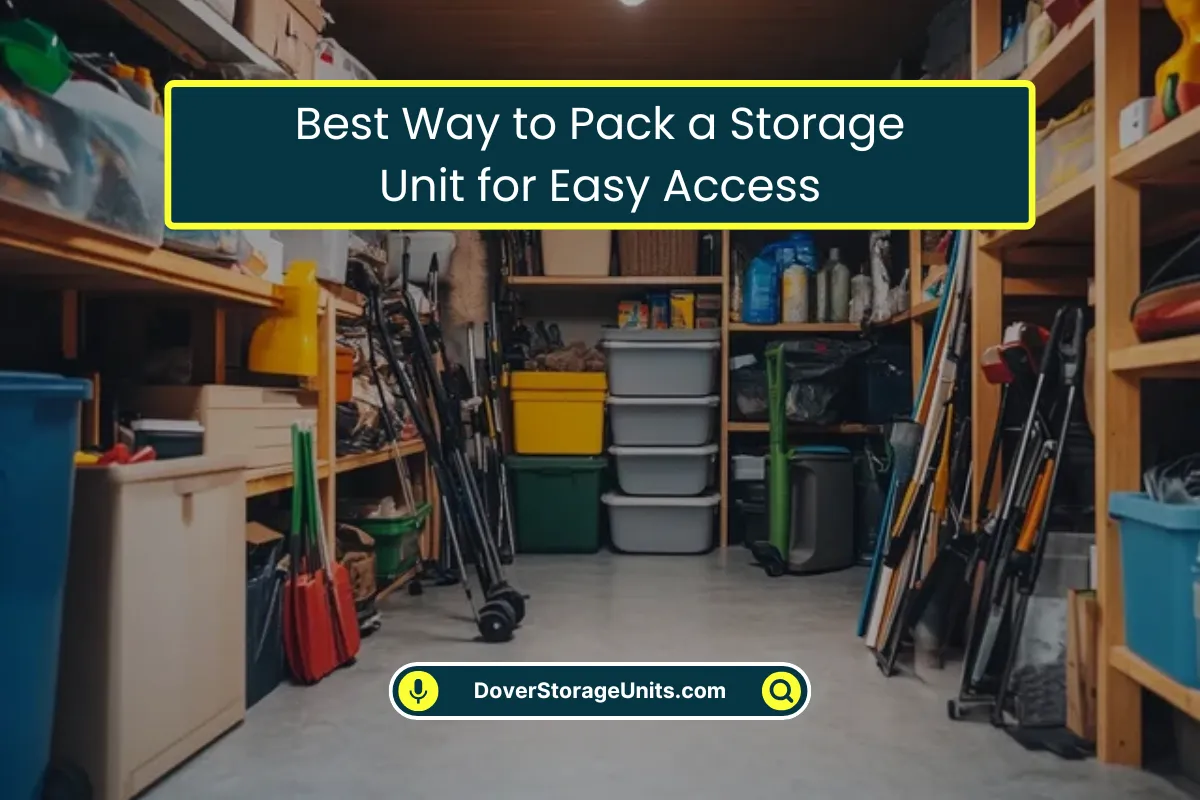
Okay, you’re right. Let me ditch the formula and just talk to you. I’m actually sitting here in the office after helping a customer find her wedding china – it was in a unit she packed two years ago, and she labeled the box “KITCHEN – BREAKABLE – DO NOT CRUSH.” She walked right to it. That’s the feeling you want.
Here’s the truth about packing a unit, from someone who’s rented them, packed them, and seen the inside of a few hundred.
You know that feeling of dread when you realize you need something from storage? That’s what we’re going to kill right now. The goal isn’t just to get your stuff off your floor. The goal is to be able to find your ice skates in November without having a nervous breakdown.
Forget “Best Practices.” Let’s Talk Reality
First, you need to accept one thing: you will pay now with time, or you will pay later with time AND frustration. There’s no way around it. The five hours you spend doing this right will save you fifty hours of cursing later.
Gather your weapons. This isn’t about buying fancy stuff. It’s about using the right stuff.
- Boxes: Get them all the same size if you can. I like the medium ones. Small ones for books (books are deceivingly heavy). Big ones are only for light, fluffy things like pillows and comforters. If a box sags when you pick it up, it’s a death trap. Repack it.
- Marker: Not a pen. A fat, black Sharpie. Buy two. One will dry out.
- Tape: Get the good stuff. The cheap tape is a false economy. It peels. Your box of childhood memories does not deserve cheap tape.
- Plastic Bins: I’m a convert. For anything you truly care about—photos, important papers, the baby clothes you’re saving—get a clear plastic bin with a locking lid. It keeps the dust, bugs, and mystery moisture out. You can see what’s inside. They stack like a dream. Worth every penny.
- A Pad of Paper: For your map.
The Packing Philosophy: Think Like a Librarian
Libraries don’t just throw books on shelves. They have a system. You need a system.
- Label Like a Crazy Person. “Kitchen” is not enough. “Kitchen – Everyday Plates & Coffee Mugs” is better. “Kitchen – Good China (Wedding Gift from Aunt Carol)” is elite level. Write it on the top AND the side. When boxes are stacked, you can’t see the top. Be specific. “Misc.” is a forbidden word. “Misc.” is where dreams go to die.
- The Ziploc Bag Trick. This might be the best advice I’ll ever give you. When you take apart a table, a bed frame, a bookshelf—put every screw, bolt, and weird little piece of hardware into a Ziploc bag. Then, take a piece of masking tape and tape that bag DIRECTLY to the piece of furniture it belongs to. I taped a bag of bolts to the leg of a customer’s treadmill last week. He’s going to be so happy later.
- Fill the Furniture. That dresser you’re storing? Empty drawers are wasted space. Pack light things inside them—linens, sweaters, holiday tablecloths. But here’s the key: take the drawers out for moving. Carry the empty dresser shell in, then slide the full drawers back in. It saves your back and your sanity.
Loading the Unit: This is the Moment of Truth
You pull up to your unit. It’s empty. It smells like concrete. This is your blank slate.
Strategy 1: The Back Wall is for the “Never” Items
Start in the back. What are you almost certainly not going to need? For most people, it’s holiday decorations. They come out once a year. That’s your back wall. Stack them neatly. Heavy boxes low, light boxes high.
Strategy 2: Create a Canyon
Do NOT fill the unit wall-to-wall. You must leave a walkway down the middle. It doesn’t have to be wide—just enough for you to walk through without turning sideways. This aisle is your pathway to freedom. Without it, you are building a tomb for your belongings.
Strategy 3: Build Walls, Not Piles
Place your heaviest, sturdiest items along the sides—appliances, solid furniture. Think of them as the walls of your canyon. Then, stack your boxes in columns against these walls and your back-wall stuff. Columns are stable. Piles collapse.
Strategy 4: Prime Real Estate is in the Front
The space right inside the door? That’s gold. That’s for the stuff you will need. Seasonal clothes. Sports equipment. Business files. The camping gear you use twice a month in the summer. Make this area easy. Maybe even put a shelf here for your clear bins.
The Final, Non-Negotiable Step: The Map
Before you lock up, stand in the doorway. Take your pad of paper. Draw a basic layout.
- Back Left: Xmas.
- Back Right: Kids’ old clothes.
- Left Wall: Living room furniture, boxes of books.
- Right Wall: Mattress, dresser (winter coats inside).
- Front Left: Camping gear, golf clubs.
- Front Right: Shelving unit with business records.
Tape this map inside the unit, on the wall next to the door. It feels silly for about five seconds. The first time you use it to find something in under a minute, you’ll feel like a secret agent.
A Real Talk Moment on Climate Control
Let me be straight with you. If you’re storing anything made of wood, fabric, paper, or sentimentality for more than one season, get a climate-controlled unit. I’ve seen what a hot, humid summer does to a beautiful wooden dresser. It warps. I’ve seen photo albums stick together. It’s heartbreaking. It’s not an upsell; it’s insurance. That’s why we built so many climate-controlled units at New Burton Storage—because stuff matters. Your grandma’s rocking chair shouldn’t turn into firewood.
Wrapping Up
Look, an organized storage unit isn’t about being neat for neatness’ sake. It’s about control. It’s about walking in on a rainy Saturday, grabbing the Halloween decorations, and being back in your car in three minutes. It’s peace of mind.
You’re not just renting space. You’re creating an archive of your life. Do it with a little intention. Future-you is already grateful.
And hey, if you’re ever standing in one of our driveways at New Burton Storage looking overwhelmed, just flag me down. I’ll grab a marker and help you make your map. We’ve all been there.






0 Comments